SAFETY AND LOSS
INTRODUCTION
It is the policy of US Messenger & Logistics, Inc. (USM) that every associate is entitled to a safe and healthy place to work. To this end, management will make every reasonable effort in the interest of accident prevention, fire protection, and health preservation. USM wants to provide safe and dependable transportation services that will not be compromised by any other goal or challenge.
The prevention of occupational injuries and illness is of such importance that it will be given precedence over operating productivity whenever necessary. USM's success depends on new and current customers, but also on how the general public perceives our company. Safety is a top priority because it helps stop the destruction of our assets, eliminates preventable losses, and helps remove a critical barrier to servicing our customers.
The company will strive to maintain a safe and healthy workplace. It will provide safe working equipment, necessary personal protection, and in case of injury, the best first aid and medical service available.
Job safety is as much a part of job performance as work skills. Safety rules and laws are for the protection of employees. Compliance with DOT and OSHA safety requirements, state and localjurisdictional laws and regulations are mandatory.
Our objective is a safety and health program that reduces the number of accidents, injuries and illnesses to a minimum and results in a safety record that is the best among our competitors in the industry. USM is proud to be a continual member of the National Safety Council, Chicago Chapter.
Charles Aguirre is the company Safety Manager and shall be notified immediately of all accidents, inspections, or failure of employees to comply with the Safety Policies of USML. He can be reached at 630-230-5648 or caguirre@usmessenger.net.
Recommendations to improve our Safety Program are always encouraged.
Frank Gonzales
Chief Executive Officer
This associate manual was produced to aid in the communications link between USM and our associates. Safety is the #1 priority and it gives a quick overview and spells out important information about our policies and procedures. It is a training guide that will be used for new associates and will be a handy reference for existing associates. The manual will be progressively developed and continually updated. If you have any ideas or suggestions, please let us know.
RESPONSIBILITIES
LEAD DRIVERS/ON STEET SUPERVISORS
- Be familiar with and enforce safety regulations applicable to company operations within his/her area of responsibility.
- Correct and coordinate safety activities including the motivation of employees for safe work
practices.
- Conduct safety training and meetings to assure that drivers use safety devices and protective equipment.
- Instruct all drivers and bikers in job safety and health regulations and insist on compliance.
- Conduct periodic safety inspection of the work area and initiate any corrective action needed.
- Conduct periodic safety meetings.
- Assure that all injuries and illnesses are treated and reported promptly (within 24-hours).
- Investigate all accidents, obtain all pertinent data, analyze the causes, file a complete report with the operations manager, and initiate corrective and preventive action.
- Enforce disciplinary actions necessary to maintain job site safety.
DRIVERS
- Comply with all the safety rules and regulations for motor vehicle drivers. Follow the "RULES OF THE ROAD".
- Drive defensively. USM would rather lose a customer for being late, than a life from aggressive driving.
- Take responsibility for his/her vehicle. Conduct proper daily pre-trip inspections and keep vehicle clean.
- Report all accidents and injuries immediately to his/her Operations Manager or Lead Driver.
- Obtain and use the proper tools required for the job at hand (hand trucks, dollies, etc.)
- Report all unsafe conditions to his/her supervisor immediately.
- Know what emergency telephone to call in case of fire or personal injury. 630-286-0550.
- Help maintain a safe and clean working environment.
- Always act in the best interest of our clients.
BIKERS
- Comply with all the safety rules and regulations for over the road drivers. Follow the "BIKERS RULES OF THE ROAD".
- Bike defensively. USM would rather lose a customer for being late, than a life from over aggressive biking.
- Take responsibility for his/her bike. Conduct the proper daily pre-trip inspections and keep vehicle in top operating condition.
- Report all accidents and injuries immediately to his/her Operations Manager or Lead.
- Obtain and use the proper tools required for the job at hand (messenger bag, rain gear, clipboards, etc.)
- Report all unsafe conditions to his/her supervisor immediately.
- Know what emergency telephone to call in case of fire or personal injury. 630-286-0550.
- Always act in the best interest of our clients.
The following section although originally written for our motor vehicle operators can and should be utilized by our biking associates too. Please review this information and the more directly the information later in this manual specifically pointed to bike messengers in our company.
CELLULAR TELEPHONE POLICY
INTRODUCTION
In order to ensure the safety of associates, associate dependents and the traveling public, and reduce exposure to risk of financial loss relating to automobile liability and workers compensation, we have developed this policy related to the use of cellular telephones while driving vehicles. This policy applies to all employees or others while driving company owned, leased, or personal vehicles used in conjunction with company business. Further, it applies, as described later herein, to other employees who contact users of cellular telephones.
Recent studies related to “distracted driving hazards” show individuals have an inherent cognitive capacity beyond which drivers are incapable of devoting the necessary attention to the primary task of driving. This incapacity can make them a hazard to themselves and to others with whom they share the road. Although this policy is directed toward cellular telephone usage while driving, it should be considered applicable to the use of other devices such as laptop computers, GPS and others, both currently available and yet to be produced, while driving.
PURPOSE
The purpose of this policy includes:
- Guidance to associates whose responsibilities include driving company owned, leased, or personal vehicles while in the performance of company business. This guidance also applies to dependents while driving owned or leased vehicles in accordance with the company’s fleet policy.
- Guidance in the identification of situations affecting the relative risk exposure of cellular telephone usage while driving.
- Guidance to others who may have need to contact (call) associates who may be answering on cellular telephones.
The following is meant to serve as a guideline. It is not intended to provide answers to every possible situation that may arise. Thus, we expect each associate, as identified above, to exercise good judgment in assessing driving environments and cognitive workloads while they are operating vehicles and applying responsible restraints on the use of portable electronic devices.
PLACING CALLS
Except where numbers are stored and can be dialed by pressing a maximum of two keys, or when the cellular telephone has the capability of voice recognition for dialing, no outgoing calls shall be placed by a driver without legally pulling into a safe haven and stopping to place the call. And then can only been done when utilizing a “hands free” listening/talking device approved for use by the company. Further, associates are expected to use good judgment in the placing of calls and anticipating the level of cognitive demands the conversation will require before placing a call. For instance, calling a restaurant to make a dinner reservation will require little interaction and decision making during the call. However, calling an airline to make a flight reservation, when various possible itineraries must be discussed and decided upon will take much more involvement and should not be placed while the vehicle is in motion. Obviously, any call in which the driving cellular telephone user could reasonably anticipate written confirmation must be made while legally parked. Texting is never permitted while driving.
RECEIVING CALLS
Drivers who are called while driving must make a decision quickly whether to receive the call or allow the incorporated voice mail take the call to be retrieved later. Generally, drivers should expect that each call will require extensive involvement and should therefore use discretion. It is left to the responsible decision of the driver whether to receive incoming calls, however, they may be done only when utilizing a “hands free” listening/talking device. However, once the identification of the caller is known, the driver must ask the caller to allow the driver to exit the highway/street and continue/resume or return the call. At any time the call involves recording of information, such as telephone numbers, addresses, etc., the driver must request the caller to allow the driver to seek a safe haven before continuing the call or reestablishing the connection.
CALLING A CELLULAR TELEPHONE USER
Those placing calls to cellular telephone users are expected to anticipate the level of cognitive demands the nature of the call will place upon the receiver. The caller should be sensitive to the dangers to which they could expose the cellular telephone user. Since the driving participant knows the driving environment that they are in, the decision whether to continue the conversation must be made by the driving participant. To enable the driving participant to better judge the nature of the call, the caller should advise the driving participant about the general nature and urgency of the call and whether there will be a need to convey information that will need to be written down. In most cases, if the call is of an urgent nature, it will require seeking safe haven before continuing the conversation. Also, the caller should alert the driver whether written documentation is required, automatically requiring the call be discontinued until the driver is legally and safely parked. At no time should the caller ask the driver to call them back and start to give them a number to return the call to. Rather, the caller should ask how long it will take for the driver to reach a safe haven, waiting for that period of time and then replacing the call.
These guidelines are to be applied in purpose and intent, keeping in mind your decisions will be considered by others as representative of our being the premier insurance and financial services organization in the world.
DEFENSIVE DRIVING
USM promotes defensive driving for all of our employees.
THE FIVE KEYS TO DEFENSIVE DRIVING ARE:
1.) FIND A SAFE PATH WELL AHEAD OF TIME. (Aim high in steering)
Our eyes are designed to help us gather information. Increased traveling speed requires the mind to process increased quantities of data faster to make safe decisions. Research shows that as many as 115 decisions are made to safely travel one mile in average traffic. Accurate decisions can not be made without adequate information and time. Scan as far ahead as possible to collect a full inventory of information to help you aid in these decisions. The farther ahead you see a problem, the more time you have to react.
2.) STAY BACK - SEE IT ALL. (Get the big picture)
Know what is around your vehicle at all times: in front, rear, and to the sides. Use your eyes and mirrors to see what possible hazards exist around your vehicle and only concentrate on those hazards. Stay far enough behind other vehicles to obtain the visibility required to make safe decisions. Look at the vehicles ahead and around you; not the pretty house on the comer. A house isn't going to jump out in the middle of the intersection, but a person, bike, or vehicle may.
3.) SCAN - DON'T STARE. (Keep your eyes moving)
How do you see all of the hazards around your vehicle? You must keep your eyes moving at all times. Do not focus on any object for too long, it disables your peripheral vision. Remember, the more you see the more time you have to react. Keep your eyes moving at least every two seconds and check your mirrors every five to eight seconds. .
4.) BE PREPARED - EXPECT THE UNEXPECTED. (Leave yourself an out)
Always be aware of the hazards around your vehicle. Whenever possible, keep little or no objects in the immediate space around you. The more space you have, the more area you can use if an unwanted situation arises. If you feel that you don't have enough room around your vehicle, adjust your speed and position to regain that space. Take yourself out of potentially bad situation.
5.) MAKE YOUR PRESENCE KNOWN, DON'T GAMBLE –
USE HORN, LIGHTS, AND SIGNALS. (Make sure they see you)
Don't ever assume someone sees you. Use your horn, lights, and hand signals to let other vehicles and people know you are close. This does not guarantee safety, but it indicates that people see you.
Your safety is very important to us. Please remember that USM promotes defensive driving for all of its employees. Defensive drivers recognize potentially hazardous situations sufficiently in advance to allow time to safely avoid them; taking into account adverse conditions and mistakes of other drivers.
- Defensive driving requires the knowledge and strict observance of all traffic rules and regulations applicable to the area in which the vehicle is being operated.
- Defensive driving requires a constant alertness for the acts and driving errors of other drivers and the willingness to make timely adjustments to one's own driving so these illegal acts and errors do not result in an accident.
- Defensive driving requires an intelligent adjustment of one's driving to the special hazards presented by abnormal, unusual, or changing conditions in the mechanical functioning of one's vehicle, the type of road surface, weather, degrees of light, kind of traffic, and one's physical condition and state of mind.
- Defensive driving requires a thorough knowledge of the rules governing right-of-way and willingness to yield the right-of-way to the other driver whenever necessary to avoid an accident.
- Defensive driving requires an attitude of confidence that one can drive without having a preventable accident.
- Defensive drivers have learned to recognize worry as an accident-producing factor. They have learned to keep their troubles at home.
- The Defensive driver knows that there is a safe way to perform basic traffic maneuvers such as turning" left or right, entering a stream of traffic, crossing an intersection, passing, changing lanes, stopping, parking, etc. They know that the secret of safe driving is to do it the safe way every time.
- The Defensive driver knows that safety, knowledge, and skill are of little value if not used or only used part of the time. They know that with constant use of their knowledge and skill, they can be safe.
- Every person driving any type of vehicle for USM will drive defensively.
GENERAL DRIVING MANEUVERS
LOOKING AHEAD
Looking ahead helps you stay ready for the mistakes of other drivers and pedestrians. Some drivers are content to look no farther ahead than their front bumpers: these drivers don't see anything ahead and can't react to problems when they occur. Periodically look as far ahead as you can to see if any problems are developing. A sign of several brake lights might indicate that a problem lies ahead. With this extra time you can take the proper precautions to avoid it.
Try to avoid following oversized vehicles. This cuts down on your field of vision and your reaction time.
Check your blind spots and the blind spots of other vehicles. If you can't see a driver's eyes in their mirror, that driver probably can't see you.
Check your mirrors every 5-8 seconds.
RIGHT-OF-WAY RULES
These rules are based on safety and courtesy; they do not give you any rights. Right-of-way is something you give, not take.
PEDESTRIANS - Pedestrians always have the right-of-way. Don't assume that a pedestrian will stop for you or sees you, especially at night.
INTERSECTIONS - You must yield the right-of-way to any vehicle that has entered the intersection from the right or is approaching from the right. Always look to your left; even though you may have the legal right-of-way, make sure the other driver is yielding before you proceed.
FOUR WAY STOP - If a vehicle arrived at four way stop first, they have the right-of-way. If both vehicles arrive to four way stop at the same time, the vehicle to your right has the right-of-way.
TURNING LEFT - When making any left turn you must yield the right-of-way to oncoming traffic, vehicle already in intersection, any pedestrians or bicycles in your path. ROTARIES - You must yield the right-of-way to any vehicles already in the rotary.
FOLLOWING OTHER VEHICLES
Rear-ending accidents accounted for 30% of all accidents in 2007.
A safe following distance is the amount of decision space you allow between your vehicle and the vehicle in front of you. It is that margin of safety that allows you time to react to the driver ahead if he decides to stop, turn, or slow down so you can take decisive action to avoid a collision.
During recent years the concept of "timed interval," also referred to as the "two-second rule," was introduced and came into wide spread use. This concept takes the guesswork out of trying to judge following distance by vehicle lengths.
The rule is one second of following distance for every 10 feet of vehicle length. Lengths are considered in even amounts to maintain simplification. All cars are considered to be 20 feet long, even in the case of compacts and subcompacts. The following chart illustrates the "two-second rule":
| |
Vehicle Length |
Seconds of Lead Time |
| |
|
|
| All passenger cars |
20 feet |
2 |
| |
|
|
| Trucks |
Up to 30 feet |
3 |
| |
31 to 40 feet |
4 |
| |
41 to 50 feet |
5 |
| |
51 to 60 feet |
6 |
For units over 60 feet, add one second for each additional unit.
If someone behind you is following too closely, don't panic. Slow down gradually until the driver gets the message to back off or passes you. At the same time, you are increasing your stopping distance.
Here are some techniques for avoiding rear-end collisions:
- Pay strict attention to your driving when you are following another car. Keep the proper space cushion.
- Be aware of diminishing distances between you and the vehicle ahead of you. This is often your only warning of danger.
- Cover the brake pedal the instant you see brake lights come on.
- Know what is in front of you by aiming high in steering.
- Keep looking ahead to see what is happening down the road.
- Allow extra distance for bad weather days.
- When in doubt, cover the brake.
INTERSECTIONS
If every driver practiced defensive driving all of the time, there would never be any "intersection" accidents. Crossing intersections with long vehicles present problems for those vehicles that other drivers don’t have. Be aware that the length and slow acceleration of trucks and buses takes a lot more time to cross and clear intersections.
- Approach the intersection at a speed safe for the condition of the road, traffic, and visibility. Regardless of the right-of-way, be ready to stop before entering the intersection.
- At blind comers, approach slowly, with the right foot on the brake pedal.
- Make sure other vehicles are going to stop for the red light.
- Obey all traffic signs and signals, particularly not running the yellow or jumping the red.
- Don't rely on others obeying the traffic signals or signs.
- Don't start on green if you can't see because of vehicles beside you.
- Be alert for turns of other vehicles.
- Allow oncoming traffic to clear before turning left.
- In preparing to turn right, reduce the gap between the right side of the vehicle and the curb to such an extent that another vehicle cannot overtake you or attempt to pass you on the right.
WHEN BACKING
Backing a motor vehicle can range from a relatively simple and safe act to one involving difficulty and danger. Backing into a pole or other stationary object usually results in only property damage but what happens when a pedestrian is backed over or pinned? Backing accidents accounted for approximately 14% of liability accidents in 2002.
All backing accidents are avoidable! A driver's visibility toward the rear is limited, but this only creates the need for using extra care and caution.
You should try to avoid or reduce backing your vehicle whenever possible.
- Park in a place that allows you to pull out, rather than back out.
- Choose a curb space where you can pull forward instead of having to back - even though you might have to walk a little farther to get to your destination.
BACKING PROCEDURES
- Arrange and drive your route to avoid backing whenever possible.
- Scan area for people and obstructions before entering vehicle. Don't rely on mirrors alone. Be alert to low clearances (overhead doors, overhangs, wires, and underpasses).
- Open window and turn radio down.
- Sound horn before backing.
- Try to back immediately and to the drivers side.
- Back slowly.
- Avoid driveways, dead-end alleys, and narrow streets if possible.
- Use the buddy system whenever possible.
- When in doubt: stop, get out, and check situation.
CHANGING WEATHER CONDITIONS
The Fundamental Speed Rule for motor vehicles states that, at all times, you must never travel faster than is reasonable and proper for the current conditions and public safety; regardless of the posted speed limit. Changes in weather dramatically change the proper speed that a vehicle should travel. Weather changes drastically reduce your visibility and the traction your vehicle has on the road.
DRIVING IN RAIN OR FOG
Rain and wet roads make it harder to start, stop, and turn. Hard rain, fog, and mist can cut down on your visibility dramatically. Slow down at the first sight of rain. Many roads are most slippery when rain first mixes with road dirt and oil to form a greasy film on the road surface. The tires on your vehicle can easily loose traction or hydroplane. Hydroplaning means your tires are riding on a layer of water and have lost all contact with the road, which means you have lost all control of the vehicle.
The following are tips for driving in the rain or fog:
- Because of the possibility of less traction, increase your following distance for a safe cushion in case you need to stop.
- Be careful of wet leaves on the roadway; they can be as slippery as ice.
- Make sure your tires, windshield wipers, and window defoggers are in good condition.
- In fog, use your low beam headlights to reduce glare. This might not help you see any better, but it will help other vehicles see you.
- Avoid driving through puddles. This can reduce the effectiveness of your brakes.
- If it is hard to see the pavement or road signs, slow down until you are sure of your position on the road.
DRIVING IN THE WINTER
Driving in the winter is probably the most difficult and hazardous situations both for new and experienced drivers. You should practice driving in winter conditions because motor vehicles handle much differently on ice and snow than they do on warm, dry pavement.
The following are tips for driving in snow:
- Reduce your speed according to winter conditions. Drive with caution and accelerate gently.
- Never lock your brakes on icy roads because you lose steering control. Turn into the skid.
- Increase your following distance to allow more reaction time.
- Remember that bridges and highway overpasses freeze first because the earth does not insulate them. Make sure your tires, windshield wipers, and window defoggers are in good condition.
- Remove all snow and ice from your vehicle. Clear all windows, windshield wipers, headlights, brake lights, and the roof. Cleaning the roof will stop snow from blowing off and hindering your vision and the vision of other drivers.
- Keep the gas tank at least half full to prevent fuel from freezing.
- Make sure your windshield washer fluid is full.
PASSING
In general, the law requires you to drive on the right side of the road. When passing is permitted, you should pass on the left. Passing on the right is only allowed in certain situations.
- Never exceed the speed limit.
- Keep a safe distance between the two vehicles. Assume the driver in front of you doesn't know your passing.
- If passing: signal left and move into the passing lane, maintain proper speed until you safely pass other vehicle, when safely past other vehicle move back into the right lane.
- If the vehicle you are trying to pass speeds up, let it go. Don't get into a dangerous race. If being passed you must slow down and stay to the right. Allow the other driver to pass safely, DO NOT speed up.
- Don't take unnecessary risks. If in doubt, DON'T PASS.
SAFE OPERATION OF VEHICLE
- No driver is permitted to operate a motor vehicle when their ability or alertness is impaired by fatigue, illness, or any other cause that makes it unsafe to begin (or continue) to drive the vehicle.
- No driver may be on duty and possess, be under the influence of, or use drugs or alcohol.
- No one may drive or require anyone to drive a vehicle unless the cargo is loaded properly and secured. A driver must not drive before correctly restraining him/herself with the proper seat belt assembly. A driver may not be in possession or use a radar detector.
- A driver may not use a vehicle unless it has passed a pre-trip inspection.
ILLNESS AND FATIGUE
- Don't start a long trip unless you sleep well before you go.
- If possible, schedule trips around normal sleeping hours.
- Be careful with any type of medication, most medicines can make you drowsy.
- If you feel you are too tired to drive, DON'T DRIVE!!!
PARKING
Parking on or partially on a travel lane creates a hazard. This is especially true at night. Most drivers do not expect to see a parked vehicle in the road and they may not be able to react quickly enough to avoid a collision.
- Always park your vehicle off of the road altogether. Even leaving a small portion of your vehicle on the travel lane creates a serious hazard.
- If you pull off the shoulder, turn your flashers on day or night. At night, drowsy drivers who see taillights on your vehicle may follow you onto the shoulder thinking you are still moving.
- If a sudden breakdown or other emergency forces you to park on a travel lane, turn your flashers on immediately. Then set up your reflective triangles at the proper distances immediately. Call for assistance immediately and be extremely careful.
BIKING SAFETY
Do wear your company issued vest with ID number and your helmet whenever you are working. It’s in your best interest to be safe – wear it whenever you’re on your bike! SAFETY FIRST!
Do not drive against traffic! Yes you are small and quick – BUT… people don’t expect vehicles to go against traffic. Always ride with traffic! Ride on the right side of traffic. It’s not only safe thinking… it’s the law!
Use and obey traffic signals. Cars are not expecting to see a bike jarting through a red light! Remember you must follow all traffic regulations while using the roadways! Why not be safe and smart?
Do not cut between parked vehicles (Jay-Walk your bike)
Do look both ways when crossing streets and intersections – GET THE BIG PICTURE!
Be on the watch for people that will open their car doors without looking. ESPECIALLY CABS! You can see when someone’s in the parked cars – if you’re getting the “big picture.” That requires concentration though! Be alert – even if they’re not!
Never ride on any sidewalk! Walk your bike.
Keep your bike in top shape! Check brakes and chain often.
Do not accept deliveries that would make your trip “unsafe.” You must make the call – if your dispatcher gives you a delivery in which could cause damage to the client property or worse yet to you! Don’t bike unsafe!
Use your messenger bag to hold customer property. Don’t carry it in your hand or under your arm. If it were your property – how would you want it carried and delivered? It’s easy when you think about it that way! Be smart – BE SAFE! Use two hands on your bike!
Watch for pedestrians that may Jay Walk or jart out from between two parked cars. People on cell phones don’t always look for bikes (or cars for that matter.)
If you are on a prolonged phone call – pull over. Be safe! Safety First!
Get proper rest and nutrition for the job at hand! Biking for a living is hard work! Do not work if you are tired or under nourished! Drink plenty of water – stay hydrated too!
Don’t escalate “in-traffic” situations. It’s easy for us to say that – we’re not there! However, use your head – be non-confrontational and courteous at all times – you’re representing the foremost company in the business! Act that way! “Road Rage” bring us down to – their level!
Communicate any problem or issue that you may have with your dispatcher as soon as possible. The dispatcher is thinking what to give you next. If you “disappear” because you had a flat tire then a customer may not get the service that they expected. These things happen! When they do – COMMUNICATE!
Helmet
ALWAYS wear your bike helmet: it can protect you from head injuries in the case of an accident. The helmet should fit snugly and sit flat on top of your head, not tilted backward. Buckle the chin strap securely and ensure that the helmet does not interfere with your vision.
Eyes: When you look up you should see the front rim. If not, your helmet won’t protect your forehead.
Mouth: When you open your mouth wide, you should feel the helmet push down on your head. If your helmet doesn’t pass the test, adjust the straps or add bigger pads to get the right fit.
Ventilation: Good air flow comes from long, wide vents that channel air through the helmet to keep you cool.
Replace your helmet if it becomes damaged in an accident. Also replace a helmet every two years. The foam inside becomes hard and stale and will not absorb shock as well as it should.
Proper Bike Fit Can Prevent Pain and Injury
Adjusting the Saddle
Your bike seat should be level to support your full body weight and allow you to move around on the seat when necessary. Too much upward tilt can result in pressure points. Too much downward tilt can make you slide forward while riding and put extra pressure on your arms, hands and knees, which can lead to injury.
To adjust the seat height, wear your biking shoes and riding shorts and place your heels on the pedals. As you pedal backwards, your knees should fully extend in the down position. If your hips rock side to side the seat is too high. Now when you move your foot into the proper pedaling position, with the balls of your feet over the pedal, you'll have a slight bend in your knees.
You can also adjust the seat forward and backward (fore and aft position). With your feet on the pedals so the crank arms are parallel with the ground, the proper position will put your forward knee directly over the pedal axle. Dropping a plumb line from the patellar tendon makes this adjustment a bit easier to see.
Handlebar Adjustment
If the handlebars are too high, too low, too close, or too far away, you may have neck, shoulder, back, and hand pain. A proper reach allows you to comfortably use all the positions on the handlebars and to comfortably bend your elbows while riding. There are other, more advanced adjustments you can make, such as changing the handlebar width or height.
Because your body is asymmetric (one leg or arm may be slightly longer or shorter than the other) an ideal bike fit is often a matter of trial and error. The slightest imbalance can lead to pain. Here are some common complaints and possible solutions.
Knee pain is usually associated with a seat position that is too high or low or far forward or back. Improper bike shoe or cleat position can also cause knee pain.
A seat that is too high will cause pain in the back of the knee.
A seat too high will also cause your hips to rock side to side, which may cause discomfort.
A seat that is too low or too far forward may cause pain in the front of the knee.
Improper foot position on the pedal (or improper cleat alignment) can cause pain on the inside or outside of your knees.
Individual anatomy may also result in knee pain. Cyclists with slight differences in leg length may have knee pain because the seat height is only adjusted for one side. Shoe inserts or orthotics can help correct this problem. Another cause of knee pain is using too high a gear. Try to use a gear that allows you to pedal quickly, from 70 to 100 strokes per minute.
Neck pain is another common cycling complaint, and is usually the result of riding a bike that is too long or having handlebars that are too low. Tight hamstring and hip flexor muscles can also cause neck pain by forcing your spine to round or arch, and your neck to hyperextend.
Foot pain or numbness is often the result of wearing soft-soled shoes. Special shoes designed for cycling have stiff soles that distribute pressure evenly over the pedal. This also helps you pedal more efficiently. Foot pain can also be caused by using too high a gear, which results in more pressure where the foot meets the pedal.
Hand pain or numbness can be prevented by wearing padded cycling gloves that provide cushioning. You should ride with your elbows slightly bent, not straight or locked. Bent elbows will act as shock absorbers and help absorb the bumps in the road. Changing hand positions on the handlebars can also reduce pressure and pain.
LOADING DOCK SAFETY
When walking on or near docks different safety concerns arise. It is very important to walk not run across docks. It is also very important to know where the edge of the dock is at all times. In addition, certain dock floors are inclined. Special care is necessary to make sure that you maintain your balance while walking on these inclined walks or ramps.
The use of ladders on docks requires non-slip shoes. Please make sure that you do not lose your balance when going up or down these ladders.
Basic Awareness Promotes Loading Dock Safety
Employers can use these reminders about hazards that face workers on loading docks. Employees should be aware of their surroundings and the operation of forklifts and other material-handling equipment. Primary loading dock hazards include:
- Slips on wet or oily floors.
- Falls from the edges of docks.
- Falls because of unsecured dock plates.
- Carbon monoxide exposure from trucks and material-handling equipment.
- Back injuries from poor lifting or carrying practices.
- Head and eye injuries.
- Hearing damage from too loud noise levels.
- Injuries from careless forklift operation.
Prevent Slips, Trips, and Falls
Slips, trip, and falls are among the most common loading dock injuries. With so much activity occurring in a small area with materials and equipment, workers are at great risk of injury unless proper precautions are taken:
- Spills, leaks, and wet spots need to be cleaned up immediately.
- Cracks, holes, or other floor damage should be repaired.
- Dock plates, wedges & handtrucks should be properly placed.
- Containers, packaging, and tools should be kept clear.
- Trash should be removed and disposed of properly.
- Workers should be encouraged to walk carefully and stay clear of dock edges.
- Horseplay and other unsafe behaviors must not be allowed.
- Employees must be taught how to use dock equipment safely.
Safety Precautions Required Around Vehicles
Some injuries occur when workers are hit by equipment operating in the dock area. Other accidents occur when trucks and trailers aren't properly secured and shut down. Rules for vehicle safety include the following:
- Truck drivers should turn off engines to prevent carbon monoxide release.
- Forklift operators should ensure trailers are secured and safe to enter.
- Loading dock employees should be prohibited from riding on forklifts or distracting operators.
- Loading dock employees should stay clear of vehicles and material-handling equipment.
With some basic awareness, training, and enforcement of safe practices, the loading dock can be a safe place for all employees who work there
WALKING – ON AND OFF THE JOB
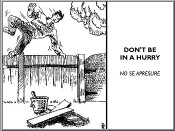
DON'T BE IN A HURRY
Trips and falls often occur while people are in a hurry, because they often take short cuts and don't pay attention to what they are doing. (See drawing below.) We all have tried to jump across an obstacle instead of walking "the long way around" to our destination. These types of acts are unsafe. Learn to slow down and walk sure- footedly by avoiding potentially hazardous short-cuts.
PAY ATTENTION TO YOUR STEP
Avoid injuries by paying attention to where you are walking. Learning to recognize hazards and avoid potential hazards saves time, money and injury. As mentioned previously, resist the temptation to take short-cuts because short-cuts are usually comprised of objects or routes not designed for foot traffic and often consist of unstable, shaky or slippery surfaces. Take note of icy or slippery surfaces.

PRACTICE WALKING SAFELY
If you cannot avoid walking on slippery or wet surfaces, practice walking safely across them. Don't try to run, jump or slide across these slick surfaces. Instead, take slow, short steps with your toes pointed slightly outward. For additional balance, keep your hands at your sides (not in your pockets) to support you if you begin to fall. Remember that a freshly polished floor can also be very slick even though it doesn't usually appear hazardous.

MATERIAL HANDLING
Despite the use of mechanical material handling equipment, many boxes, crates, bundles, and piles of material still must be moved manually. This chore can lead to one of the most painful and costly work injuries employees suffer - the back injury.
Strains, sprains, fractures, and bruises are the most common injuries. The majority of these injuries are caused by unsafe work practices such as improper lifting, carrying too heavy a load, or failing to wear proper equipment.
The proper lifting technique should be used at all times. It doesn't matter if you are lifting a cardboard box or one sheet of paper, train yourself onto the habit. Once you train yourself, it will become second nature. If the load is too large or too heavy to carry by yourself, get help.
PROPER LIFTING TECHNIQUES
A FIVE STEP GUIDE TO SAFE LIFTING
1. Get a firm footing with your feet apart for a stable stance. Stand close to the load Squat (DON'T BEND AT THE WAIST). Take a deep breath and tighten your stomach muscles to help support your back under the load.
2. Lift with your legs. They are a lot stronger than your back; bring your back to the vertical position.
3. Hold the load close to your body. This puts less strain on our back.
4. If you must turn, turn with your feet. Do not turn by twisting your back.
5. Set the load down again by squatting, not by bending your back. Always keep your fingers out from underneath the load.
HAND TRUCK SAFETY
Many back injuries are a result of lifting heavy or awkward loads. They can sometimes be prevented simply by using a hand truck. Hand trucks can make much easier work of moving heavy objects and save people many trips when moving large quantities of goods. There’s no hard and fast rule on when to use hand trucks, but common sense should tell you when a load is too heavy or cumbersome to lift manually.
Weight – When loading a hand truck, position the load so that the truck’s axles (rather than the handle) bear most of the weight.
The Right Tool – Hand trucks with hard wheels roll better on soft surfaces whiled hand trucks with soft wheels roll better on hard surfaces.
Ramps – Always position a hand truck so that it is in front of you when going down a ramp and behind you when going up a ramp.
Shifting – Before moving a hand truck, make sure its load is secure and stacked with the heaviest objects on the bottom. Strap the load to the hand truck if it is unsteady or in danger of shifting.
Vision – Try to avoid stacking a load so high that it is impossible to see over it. If it is necessary to load a large item that obstructs the truck operator’s view, a second person should assist in guiding the load.
HAND TRUCK HAZARDS
What takes a little more thought is choosing the right hand truck for the job. Make sure you choose one that is the right size and design to handle the load. Curved bed trucks, for example, are designed to handle drums.
Two-wheeled hand trucks look easy to handle, but it’s just as easy to lose the load and injure yourself or a co-worker if you don’t keep safety in mind. When loading any hand truck:
- Follow proper lifting techniques to place the load on the hand truck. Use your legs, and keep your back straight.
- Place the heaviest objects on the bottom.
- Position the load so it rests on the axles so the weight will be carried by the truck and not the handles.
- Make sure the load will not slip, shift or fall. This may require securing it to the truck.
- Move forward – not backward – with a hand truck. If you’re going down a slope, keep the load in front of you. If you’re going up, keep it behind you.
- Move slowly and cautiously.
- Make sure you can see over the load.
Four-wheeled hand trucks are similar to the two-wheeled. Four-wheeled can be easily tipped, so make sure that your load is balanced and secure. They should generally be pushed instead of pulled. Also, be sure that you can see over the load.
INJURY REPORTING
Your failure to report a work-related injury or illness in a timely manner may result in disciplinary action.
AN INJURY OCCURS - Report all injuries, no matter how minor, to your supervisor and the Safety Manager immediately. If treatment is needed, it will be provided and the incident will be recorded. To neglect a cut or scratch is to invite infection. Wounds that do not bleed are often the first to become infected. Should follow-up treatment be required, there will be record of your injury/illness. If immediate medical care is required, employee should go to closest medical provider. If possible, the employee must take the Physical Evaluation Form to be completed and the clinic or employee should return the form after each visit.
SUPERVISORS INVESTIGATION - The Supervisor must interview the employee and fill out the Supervisor's Injury Report form and forward it to the Safety Manager. He will identify the root causes of the injury and take corrective steps to stop injury from reoccurring. This form must be forwarded to the Safety Manager within 24 hours.
SAFETY MANAGERS INVESTIGATION - The Safety Manager will investigate the injury to identify causes and modify policies if necessary to prevent it from happening again. He will also follow-up on the status of the employee.
RETURN TO WORK STATUS - Prior to returning to work after an injury/illness, employees must present a medical clearance (return to work slip) from the attending physician to the Safety Manager. If the doctor returns you to work with restrictions (modified duties), your situation will be evaluated by the Safety Manager and your Supervisor to find a regular work task for you to perform.
MEDICATIONS - Prescription medications shall not be taken on the job unless authorized in writing by your personal physician and reviewed by the General Manager and the Safety Manager. A copy of this authorization shall be maintained in your confidential personnel file.
USM will attempt to place any injured employee in a light/modified work duty wherever possible.
ACCIDENT REPORTING, INVESTIGATION, AND DETERMINATION
Accident/incident investigation involves the methodical examination of an undesired event that did or could, result in harm to people, damage to property, or loss to process. Investigation activities are directed toward defining the facts and circumstances related to the event, determining the causes, and developing remedial actions to control the risks.
Unsafe practices and conditions are caused by:
- Lack of information
- Lack of skill or proficiency
- Improper or inadequate motivation/training
- Physical problems or incapability's
- Lack of supervision
- Mental problems or incapability's and stress
- Poorly maintained equipment
The following accident investigation procedures are designed to help the prompt reporting of accidents. They can only be effective and benefits to USM if they: describe what happened, determine the real causes, evaluate the risks, help develop controls, help define trends, and demonstrate concern for the assets involved (people, vehicles, customers, and freight).
1. ACCIDENT - INCIDENT REPORTING - the employee involved in the accident/incident must fill out an accident report form which contains all of the crucial information concerning other parties involved, injuries that may have occurred, witnesses to the accident, ambient conditions, and a drawing of the accident. Failure to fill out an accident report completely may result in disciplinary action. If you have a camera or camera phone please take as many photographs as possible for later use by USM management.
2. SUPERVISORS PRELIMINARY FINDINGS - The supervisor must interview the driver involved in the accident to discuss what happened and make sure the accident report is filled out completely. The supervisor must give his/her opinion if the accident was preventable or non-preventable, what are the primary causes, and document any damage to the vehicle. The supervisor must also give any recommendations as to what action should be taken or has been taken in regards to disciplining the employee. The report must be forwarded to the Safety Manager within 24-hours.
3. SAFETY MANAGERS DETERMINATION - The Safety Manager must analyze the reports and determine if the accident was preventable or non-preventable and the primary causes. He/she may also have to interview the driver involved. Every accident is different and must be treated uniquely. Accidents involve so many different factors that it is impossible to set a strict set of rules to classify them as preventable and non-preventable. Defensive driving is based on a concept that a driver has the ability to avoid accidents in spite of adverse weather conditions and the mistakes of other drivers. What may seem non-preventable at first glance may actually have been preventable if the driver took the proper precautions.
4. RECOMMENDATIONS/ACTION - The driver will be informed of the actions to be taken concerning the accident; no fault, probation, verbal warning, written warning, suspension, or termination. The driver will receive a letter explaining the reasons for the disciplinary actions taken. The action taken will be reflective of the severity of the accident and where the fault lies.
5. CHIEF EXECUTIVE OFFICER’S DECISION - The Company CEO will review the case, with recommendations, and may either impose a lighter or more severe penalty.
The following infractions may result in immediate termination of said employee:
- Conviction for driving under the influence of alcohol or controlled substances
- Reporting to work under the influence of alcohol or controlled substances
- Possession, sale, transfer, or consumption of alcohol or controlled substances while on duty or on company owned or leased property
- Failure to report an on-the-job injury or vehicular accident
- Unauthorized passenger or unauthorized driver
- Personal use of company-vehicles
- Failure to follow all of the policies set forth in the USM Safety and Loss Control Plan
- Involved in a preventable accident depending on the fault and severity - the separation will depend on the carelessness demonstrated by the driver
- Any unsafe operation of sufficient magnitude
- Any two violations from the drivers MVR and/or unfavorable observations within a one year period.
- Three drivers alert notices within a one year period
- Repeated failure to wear seatbelt
- Use of radar detection equipment in a company vehicle
- Possession of firearms or weapons in or on company or customer property or at any time while on company business.
IN CONCLUSION
The National Safety Council has compiled the following statistics to show how unsafe driving affects us all:
- For every 500 unsafe behaviors, there are 100 near misses.
- For every 100 near misses, there are 30 less than serious accidents.
- For every 30 less than serious accidents, there are 10 serious accidents.
- For every 10 serious accidents, there is 1 catastrophic accident.
As individuals that utilize public roadways, you must realize every day you are driving or biking a vehicle that has the ability to take away a life (yes, even bikes!).
Is it really worth taking that chance trying to make up lost time; I know it isn't. Driving or Biking for a living is a profession requiring skill, knowledge, physical and mental health, and character integrity.
The only thing a driver/biker should be doing on the road is driving or biking. You should not be looking at manifests, map books, eating, or anything else that may distract you from your immediate concern: DRIVING or BIKING. If you need to look at a map book or a manifest, find a place to pull over and check.
Please remember that USM promotes defensive driving & biking and takes this concept very seriously. We want to help you identify and eliminate unsafe behaviors; which in turn minimizes the root causes of accidents.
You are encouraged to issue comments and corrections to this manual!
Remember – you represent not only yourself, but USM!
BE PROUD! BE SAFE!
ARRIVE ALIVE!